



RIPK1
RIPK1 is a stress-sensing serine/threonine kinase that coordinates cell survival, inflammatory signaling, apoptosis, and immunogenic cell death[1]. Mechanistically, RIPK1 acts within TNF-related signaling complexes, where its scaffold function restrains caspase-8- and RIPK3-dependent lethality while its kinase activity promotes regulated cell death under defined stimuli[2]. In necroptosis, RIPK1 cooperates with RIPK3 to assemble a phosphorylation-dependent complex, and RIPK3 phosphorylates MLKL to drive membrane-disruptive necrotic death[3][4]. Compared with related RIPK3 and MLKL, RIPK1 is distinguished by separable kinase-dependent death signaling and kinase-independent scaffold protection, making isoform-specific interpretation essential in experimental design[5][6]. Disease models link RIPK1 activity to ALS axonal degeneration, Alzheimer’s disease microglial responses, and human immunodeficiency or intestinal inflammation caused by RIPK1 loss of function[7][8][9]. For experimental applications, necrostatins and clinical RIPK1 inhibitors provide tools to test kinase-dependent biology, but inhibitor selectivity and scaffold-preserving effects require careful controls[10][11].
References:
- [1]. Clucas J, et al. Roles of RIPK1 as a stress sentinel coordinating cell survival and immunogenic cell death. Nat Rev Mol Cell Biol. 2023 Nov;24(11):835-852. [Content Brief]
- [2]. Dillon CP, et al. RIPK1 blocks early postnatal lethality mediated by caspase-8 and RIPK3. Cell. 2014 May 22;157(5):1189-202. [Content Brief]
- [3]. Cho YS, et al. Phosphorylation-driven assembly of the RIP1-RIP3 complex regulates programmed necrosis and virus-induced inflammation. Cell. 2009 Jun 12;137(6):1112-23. [Content Brief]
- [4]. Wang H, et al. Mixed lineage kinase domain-like protein MLKL causes necrotic membrane disruption upon phosphorylation by RIP3. Mol Cell. 2014 Apr 10;54(1):133-146. [Content Brief]
- [5]. Polykratis A, et al. Cutting edge: RIPK1 Kinase inactive mice are viable and protected from TNF-induced necroptosis in vivo. J Immunol. 2014 Aug 15;193(4):1539-1543. [Content Brief]
- [6]. Dannappel M, et al. RIPK1 maintains epithelial homeostasis by inhibiting apoptosis and necroptosis. Nature. 2014 Sep 4;513(7516):90-4. [Content Brief]
- [7]. Ito Y, et al. RIPK1 mediates axonal degeneration by promoting inflammation and necroptosis in ALS. Science. 2016 Aug 5;353(6299):603-8. [Content Brief]
- [8]. Ofengeim D, et al. RIPK1 mediates a disease-associated microglial response in Alzheimer's disease. Proc Natl Acad Sci U S A. 2017 Oct 10;114(41):E8788-E8797. [Content Brief]
- [9]. Li Y, et al. Human RIPK1 deficiency causes combined immunodeficiency and inflammatory bowel diseases. Proc Natl Acad Sci U S A. 2019 Jan 15;116(3):970-975. [Content Brief]
- [10]. Degterev A, et al. Identification of RIP1 kinase as a specific cellular target of necrostatins. Nat Chem Biol. 2008 May;4(5):313-21. [Content Brief]
- [11]. Harris PA, et al. Discovery of a First-in-Class Receptor Interacting Protein 1 (RIP1) Kinase Specific Clinical Candidate (GSK2982772) for the Treatment of Inflammatory Diseases. J Med Chem. 2017 Feb 23;60(4):1247-1261. [Content Brief]
-
RIPK1 Related Products (66)
Related Products (66)

-
Antibodies (1)
-
Necroptosis-IN-5
 0 ImagesCat. No.: HY-161911Necroptosis-IN-5 (Compound 26) is an orally active necroptosis inhibitor. Necroptosis-IN-5 also exhibits potent inhibitory activity against receptor-interacting protein kinase 1 (RIPK1). Necroptosis-IN-5 can be used to study necroptosis-related inflammatory diseases, neurodegenerative diseases, and cancers.
-
RIPK1-IN-8
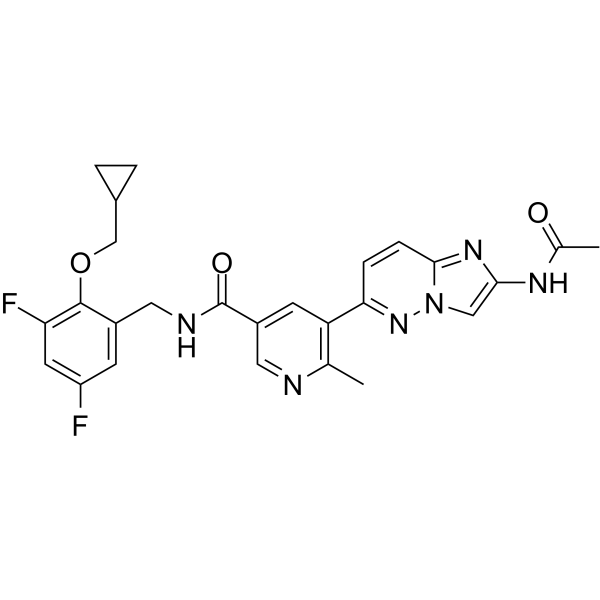 0 ImagesCat. No.: HY-143726CAS No.: 2319663-07-3RIPK1-IN-8 (example 16), an aminoimidazopyridine, is a potent and selective RIPK1 inhibitor with an IC50 of 4 nM. RIPK1-IN-8 has the potential for inflammatory diseases research.
-
RIPK1-IN-35
 0 ImagesCat. No.: HY-178762SCAS No.: 3103886-96-7RIPK1-IN-35 is a selective and orally active RIPK1 inhibitor with an IC50 of 5.33 nM. RIPK1-IN-35 has a potent protective effect against necroptosis in both human and murine cells. RIPK1-IN-35 shows good therapeutic effects in both TNF-α-induced systemic inflammatory response syndrome and DSS (HY-116282C)-induced inflammatory bowel disease models. RIPK1-IN-35 can be used to the study of inflammatory diseases related to necroptosis.
-
RIPK1-IN-32
 0 ImagesCat. No.: HY-175007RIPK1-IN-32 is a RIPK inhibitor with anti-inflammatory activity. RIPK1-IN-32 inhibits nitric oxide (NO) release with an IC50 of 3.26 μM. RIPK1-IN-32 significantly alleviates acute liver injury associated with sepsis through the RIPK1/NF-κB/MAPK pathway, therefore preventing the nuclear translocation of p65 and c-fos, which results in reduced expression of TNF-α and IL-6. RIPK1-IN-32 can be used for the study of acute liver injury and sepsis.
-
Ligustroflavone (Standard)
 0 ImagesCat. No.: HY-N0546RCAS No.: 260413-62-5Synonyms: Nuezhenoside (Standard)Ligustroflavone (Standard) is the analytical standard of Ligustroflavone (HY-N0546). This product is intended for research and analytical applications. Ligustroflavone is an orally active flavonoid compound. Ligustroflavone can be extracted from Ligustrum lucidum. Ligustroflavone antagonizes the calcium-sensing receptor (CaSR), inhibits the RIPK1/RIPK3/MLKL pathway, and downregulates TGF-β/Smad signaling. Ligustroflavone regulates calcium metabolism, protects bone tissue, reduces cerebral ischemic injury, and inhibits liver fibrosis. Ligustroflavone can be used in the study of diabetic osteoporosis, ischemic stroke, and liver fibrosis.




